
Sustainable Weight Loss: What "1kg a Week" Actually Costs Your Body
Losing a kilo a week is possible. What the promise leaves out is how much of it is muscle, what it does to your training, and why the weight usually comes back. Here is the honest arithmetic.
Fit with Faisal Noor
Certified Fitness Coach & Nutrition Specialist
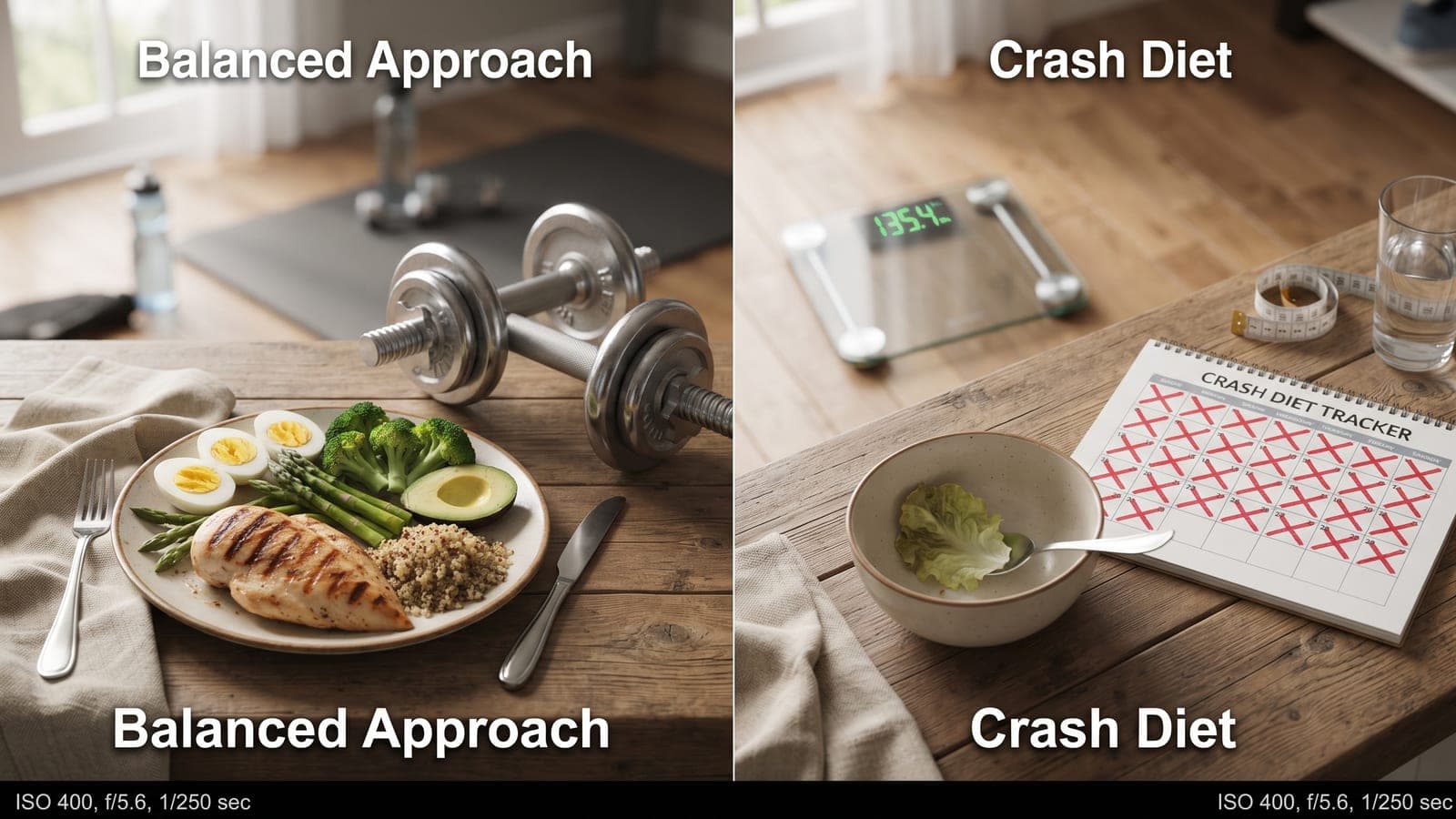
Every plan promising a kilo a week is technically describing something achievable. You can create a deficit that large, and the scale will move.
What the promise leaves out is what you lose, what it costs to hold, and what happens in month four. That is the part worth understanding before you choose a rate.
Why This Happens
Faster sounds better, and the arithmetic looks straightforward.
A kilo of body fat stores roughly 7,700 calories. Losing one kilo a week therefore needs a deficit of about 1,100 calories a day — sustained, every day, for as long as you want it to continue.
For someone with a maintenance of 2,400, that means eating around 1,300 calories while training. For a smaller person with a maintenance of 1,900, it means roughly 800, which is below their basal metabolic rate.
That is the first problem. The second is that the body does not exclusively surrender fat. At aggressive deficits a meaningful share of the loss is muscle and glycogen, and the scale reports all of it identically.
So a kilo a week is real. It is simply not a kilo of the thing you wanted to lose.
What Most People Get Wrong
Reading the scale as a fat gauge. Week one of any aggressive diet produces a dramatic drop — often 2–3 kg. Almost all of it is water and glycogen, and it returns the moment you eat normally. This is what makes crash diets feel effective and what makes the rebound feel like personal failure.
Ignoring what muscle loss does. Muscle is metabolically active. Losing it lowers your maintenance calories permanently, which means every future attempt starts from a worse position. This is the real cost of repeated crash dieting — each round leaves you needing to eat less than the last.
Assuming the aggressive phase is temporary. People plan to cut hard for eight weeks then normalise. In practice they last three, rebound, and restart. The plan that gets followed for six months beats the plan that gets followed for three weeks, every time.
Not accounting for the training cost. In a deep deficit your lifts fall. Falling lifts signal to your body that the muscle is not needed — which accelerates exactly the loss you were trying to avoid.
A kilo a week is achievable. It is just rarely a kilo of fat, and the muscle you lose making it happen makes the next attempt harder.
The Fix: Pick a Rate You Can Defend
The rate that works
0.5–1% of bodyweight per week.
| Your weight | Weekly target | Daily deficit |
|---|---|---|
| 60 kg | 0.3–0.6 kg | 350–650 |
| 80 kg | 0.4–0.8 kg | 450–850 |
| 100 kg | 0.5–1.0 kg | 550–1,100 |
Two things follow from this. Heavier people can lose faster safely, because the same percentage is a larger absolute number and they have more fat available. And as you get lighter, the safe rate falls — which is why a target set at 95 kg is too aggressive at 78 kg.
What protects muscle while you lose
Three things, and none is optional:
- Protein at 1.8–2.2 g per kg. The single most important variable. Local food covers this cheaply.
- Resistance training two to three times a week. Training gives your body a reason to keep the muscle. Without it, muscle is just tissue costing energy.
- A moderate deficit. Deep deficits overwhelm the other two.
The timeline, honestly
Someone at 90 kg aiming for 78 kg:
- At 0.5 kg/week: 24 weeks, mostly fat, lifts maintained or improving
- At 1 kg/week: 12 weeks, meaningful muscle loss, lifts down, high rebound risk
The second finishes sooner and frequently ends up back at 88 kg by month six. The first is still holding 78 kg a year later. The slower version is faster if you measure from where you actually end up.
Build in maintenance phases
For anything longer than about 12 weeks, plan a 10–14 day break at maintenance every couple of months. It restores NEAT, improves training, and makes the next block work properly. It is not lost time — it is what makes the total longer than three weeks.
What faster loss actually looks like in the mirror
The part nobody mentions: aggressive diets frequently produce a result people dislike.
Losing 12 kg with meaningful muscle loss leaves you lighter but softer — smaller clothes, same shape, less definition. This is the outcome behind "I lost the weight but I do not look how I expected."
Losing the same 12 kg slowly while training and eating adequate protein produces a visibly different result at the identical bodyweight, because the composition of what was lost differed.
The scale reports both as −12 kg. Only one of them is what you actually wanted.
The Version That Actually Applies Here
One local factor changes this calculation more than people expect: the calendar.
Between Ramadan, Eid, and wedding season, most years contain several multi-week periods where a strict deficit is unrealistic. Planning a 12-week aggressive cut straight through a wedding season is planning to fail at week five.
The workable approach is to run moderate deficits during the clear stretches and deliberate maintenance through the rest. Someone losing 0.5 kg a week for eight months of the year and holding steady for four still ends the year 15 kg down.
Work out your target rate as a percentage of your current weight, not as a round number you picked because it sounded decisive. That single change is what makes the difference between a diet and a year of progress.
Keep Reading

Supplements: What's Worth Your Money and What Isn't
Three supplements have solid evidence behind them. Most of the rest are selling you an expensive version of something food already provides. Here is the honest breakdown.

Water Intake and Weight Loss: Fact vs Overhyped Advice
Water does not burn fat, and drinking four litres will not speed anything up. What it does do is worth knowing — particularly the effect it has on the number you see on the scale.

How to Read a Nutrition Label Like a Coach (Not Like an Ad)
The front of the packet is marketing. The back is data. Here is how to read the panel in ten seconds, and the four tricks that make unhealthy products look healthy.