
How to Set a Weight Loss Goal You'll Actually Hit
"I want to lose weight" is not a goal — it has no number, no deadline, and no way to tell whether you are on track. Here is how to set one properly, and why the number you pick matters less than the date.
Fit with Faisal Noor
Certified Fitness Coach & Nutrition Specialist
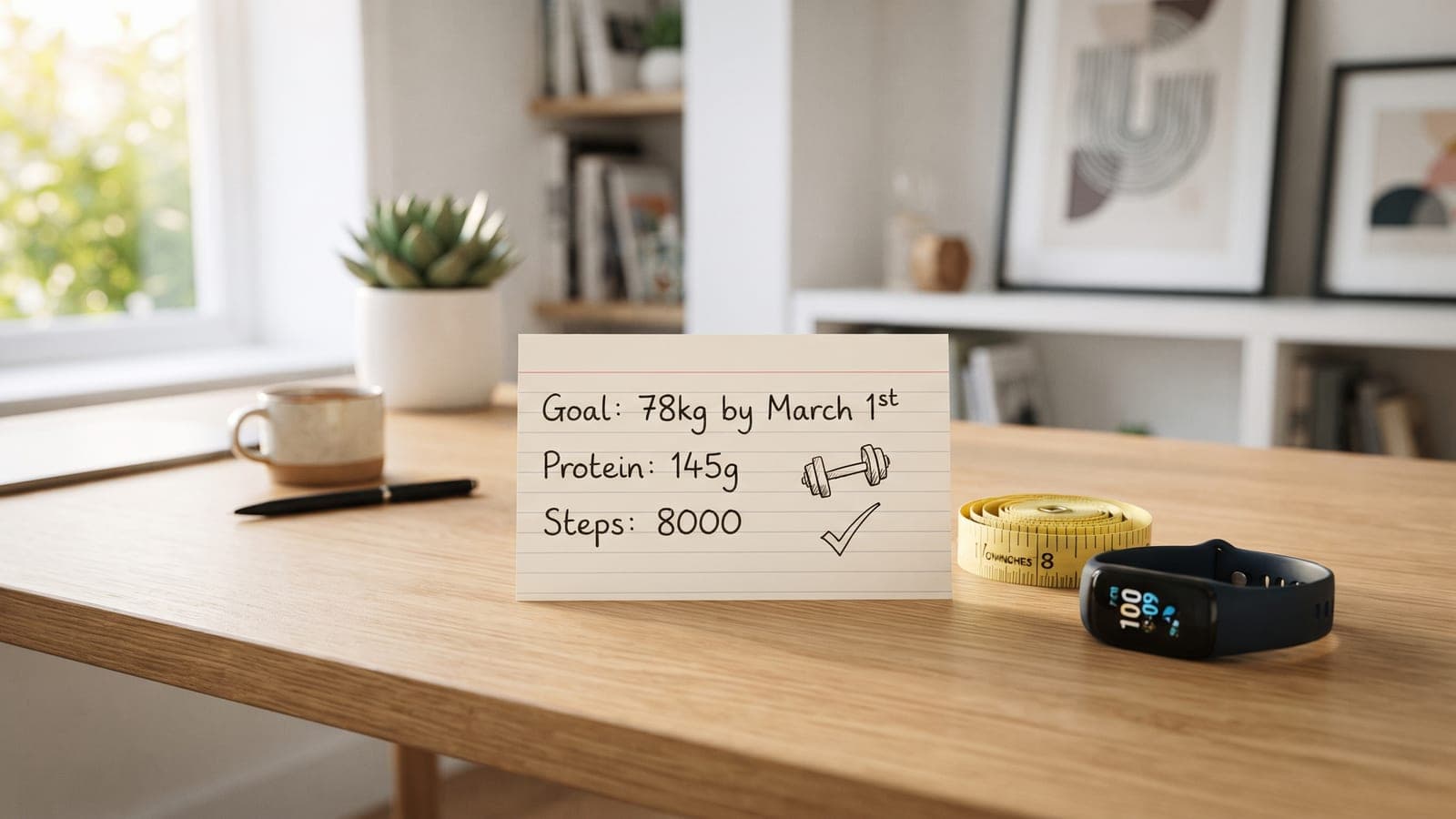
Ask ten people what their fitness goal is and most will say some version of "lose weight" or "get in shape."
Neither is a goal. They are directions. And a direction cannot tell you whether this week went well, which means it cannot tell you when to adjust — so people drift for months without knowing whether anything is working.
Why This Happens
A usable goal has three parts: a number, a deadline, and a rate that connects them. Most goals have none.
Without a number you cannot tell success from failure. Without a deadline there is no urgency and no point at which you evaluate. Without a rate you have no way to know, in week three, whether you are on track or wasting your time.
The reason people avoid specifics is understandable: a vague goal cannot be failed. "Get in shape" is permanently in progress. The moment you write "78 kg by 1 March," you have created something you might not achieve, and that is uncomfortable.
But an unfalsifiable goal is also unachievable in any meaningful sense, because nothing tells you when you have arrived.
What Most People Get Wrong
Picking a number from their past. "I want to be 70 kg like I was at university" ignores that you were twenty and carried less muscle. The weight you were at 20 may not be the weight you want at 35.
Setting a deadline that forces an unsustainable rate. Wanting to lose 15 kg in eight weeks requires roughly 1,900 calories of daily deficit. That is not a goal, it is a plan to fail — and the rate you pick determines what you actually lose.
Using only bodyweight. The scale cannot distinguish fat from muscle. Someone training properly may lose 6 kg of fat and gain 2 kg of muscle, showing a 4 kg change while looking dramatically different.
Setting an outcome goal with no process goals. "Lose 10 kg" is not something you can do today. "Hit 140 g of protein" is. Outcome goals set the direction; process goals are what you actually execute.
No review date. A goal you never check is a wish. Without a scheduled review, drift goes unnoticed for months.
A goal you cannot fail is a goal you cannot achieve. If there is no number and no date, there is nothing to hit.
The Fix
Step 1: Pick the number properly
Rather than a weight from memory, work backwards from what is realistic.
0.5–1% of bodyweight per week. At 90 kg, that is 0.45–0.9 kg weekly, or roughly 2–3.5 kg a month.
So a realistic six-month goal from 90 kg is 12–20 kg — not the 30 kg that sounds more decisive.
Step 2: Set the deadline from the rate, not the other way round
This is the step people invert. Do not pick a date and calculate the rate required; pick a sustainable rate and calculate the date.
From 90 kg to 78 kg at 0.5 kg per week = 24 weeks. That is your deadline. It is further away than you wanted, and it is the one that produces the result.
Step 3: Add process goals
The outcome goal is the destination. These are what you do:
- Hit your protein target six days out of seven
- Three training sessions a week
- 8,000 steps daily
- Log every session
You control these completely. You do not directly control the scale, which is why judging yourself weekly on process rather than outcome is both more accurate and considerably less discouraging.
Step 4: Measure more than weight
| Measure | How often |
|---|---|
| Weight | Daily, judged weekly |
| Waist | Fortnightly |
| Photos | Monthly |
| Training log | Every session |
When the scale stalls but your waist is shrinking and your lifts are climbing, you have the evidence to keep going. Without those, a normal stall reads as failure.
Step 5: Schedule the review
Put a date in your calendar four weeks out. On that date, compare where you are against where the plan said you would be.
Ahead of schedule: hold, do not accelerate. Behind: check process goals before changing the target. Usually one of them slipped. On track: change nothing.
A worked example
Outcome: 90 kg → 78 kg by 1 March Rate: 0.5 kg per week over 24 weeks Process: 145 g protein daily, 3 sessions weekly, 8,000 steps Measures: daily weight, fortnightly waist, monthly photos, training log Review: first of every month
That fits on an index card, and it is the difference between a goal and an intention.
Set a maintenance goal too
Almost nobody does this, and it is why so much weight comes back.
Every weight-loss goal should be followed by a stated maintenance period — typically as long as the loss phase itself. Losing 12 kg over 24 weeks should be followed by roughly six months of deliberately holding 78 kg before any further attempt.
That phase is not a pause or a reward. It is where your new weight becomes normal — where habits settle and your body adjusts to defending the lower number instead of fighting toward the old one.
People who skip it tend to spend years cycling: lose 10 kg, regain 12, repeat. The maintenance phase is what breaks that cycle, and it belongs in the goal from the beginning rather than being decided afterwards.
Write yours out in that format before you change anything else about your training or eating. If you cannot fill in every line, the gaps are exactly what has been missing.
Keep Reading

Why Most People Quit Their Diet by Week 3 (And How to Not Be One of Them)
Week three is when motivation has gone, results are not yet visible, and the plan starts feeling like a punishment. Here is why that specific week breaks people, and how to build one that survives it.

How to Know If You Need a Coach or Just a Better Plan
Not everyone needs coaching, and it is worth saying so. Here are the five questions that separate a knowledge problem from an execution problem — and what each one actually costs to fix.
Why "Eat Less, Move More" Advice Fails Most People (An Engineer's Take on Systems That Actually Work)
The advice is technically correct and practically useless. Here is why, borrowed from how software gets built: the problem is never the goal, it is that nobody designed the system that delivers it.