
5 Signs Your Weight Loss Plateau Isn't About Willpower
Six weeks of steady loss, then nothing for a month. Before you cut calories further or add cardio, check these five things — a stall is almost always mechanical, not a failure of discipline.
Fit with Faisal Noor
Certified Fitness Coach & Nutrition Specialist

For six weeks it worked. The scale moved every Monday, your clothes fit differently, and the plan felt easy enough to keep.
Then it stopped. Four weeks later you are eating the same food, doing the same training, and the number has not moved. So you assume you have gone soft somewhere — snacking without noticing, slacking off — and the obvious answer is to eat less and train more.
That is usually the wrong move, and it is why so many plateaus turn into abandoned plans. A stall is nearly always mechanical. Here are the five causes I see most.
Why This Happens
A plateau is not your body refusing to cooperate. It is arithmetic catching up with you.
When you lose weight, your maintenance calories fall. A lighter body costs less to move and less to maintain — roughly 20–25 fewer calories per day for every kilogram lost. Drop 8 kg and you are burning perhaps 180 fewer calories a day than when you started.
At the same time, adaptive thermogenesis quietly reduces what you spend. NEAT — the walking, standing, and fidgeting you do without thinking — falls when you are in a prolonged deficit. You take the lift more often. You sit sooner. None of it is a decision, and it can account for several hundred calories a day.
Put together: the 500-calorie deficit you set at 95 kg may be a 100-calorie deficit at 87 kg. You did not stop following the plan. The plan stopped being a deficit.
What Most People Get Wrong
The instinct is to cut harder. Drop another 500 calories, add four cardio sessions, and force it.
This works briefly and then backfires. You are already in a deficit; deepening it increases hunger, degrades sleep, reduces training quality, and pushes NEAT down further — which partly cancels the cut you just made. Several weeks of that and most people break, eat freely for a weekend, and conclude they have no discipline.
The second mistake is trusting the scale alone. If you have been training, you may be gaining muscle while losing fat. The scale reports one number for two opposite changes, and a month of "no progress" on the scale can hide a visibly different body. Waist measurement and photographs tell you what the scale cannot.
The third is not recognising that a two-week stall is normal. Water retention from a hard training block, high salt intake, poor sleep, or the menstrual cycle can mask fat loss for a fortnight. Fat loss continues underneath; the scale simply cannot see it.
Before you cut anything further, check whether you are actually still in a deficit. Most people who have "stopped losing weight" have stopped being in a deficit without realising it.
The Fix: The Five Things to Check
1. Your intake has drifted
Portions grow quietly over six weeks. The tablespoon of oil becomes two, the handful of nuts becomes a bowl, the weekend stops being tracked.
Check it: track everything honestly for four days, including cooking oil, chai sugar, and weekend meals. Most people find 200–400 calories they were not counting. This is the single most common cause, and it is not dishonesty — it is drift.
2. Your maintenance has fallen
You are lighter, so you burn less.
Check it: recalculate at your current weight — bodyweight in kg × 30, minus 400. If your target has not changed since you started, it is almost certainly too high now. The full method, including the more precise BMR calculation, is in how many calories you actually need.
3. Your step count has dropped
NEAT falls in a deficit without you deciding anything.
Check it: compare your daily steps now against six weeks ago. A drop from 9,000 to 5,000 is roughly 150–200 calories a day, and it is invisible unless you look.
4. You are measuring the wrong thing
Check it: take a waist measurement and progress photos in the same light and clothing every two weeks. If the waist is shrinking while the scale holds, you are recomposing — losing fat and gaining muscle. That is a good outcome the scale is not equipped to report.
5. Sleep and stress
Poor sleep raises appetite, reduces training output, and increases water retention. Five hours a night for a fortnight can flatten the scale on its own.
Check it: if you are averaging under six hours, fix that before touching your calories. It is a bigger lever than another 200-calorie cut.
A Note on Ramadan and Dawat Season
Two periods reliably produce stalls here, and both get misread as personal failure.
Ramadan compresses eating into a window that often ends up higher in calories than a normal day — fried items at iftar, a heavy sehri, and far less daily movement. Weight frequently holds or rises despite a full day of fasting. That is not a metabolic mystery; it is the total for the day.
Wedding and dawat season does something similar over a longer stretch. Three heavy meals across a fortnight will not undo months of work, but three heavy meals a week for six weeks will hold the scale flat indefinitely.
Neither needs a stricter plan. Both need the same adjustment: keep protein high at the meals you control, keep your step count up, and accept a maintenance phase for those weeks rather than pretending a deficit is still running.
What to Actually Do
Work through the five in order. Four times out of five the answer is in the first three, and the fix is small — recalculate the target, restore the step count, tighten tracking for a fortnight.
If all five check out and you have genuinely held a consistent deficit for four weeks with no movement in weight or waist, then take a diet break: eat at maintenance for 10–14 days. It restores NEAT, improves training, and makes the next deficit block work properly. It feels counterintuitive and it is usually what breaks the stall.
A plateau is information, not failure. It tells you a number needs updating — nothing about your discipline.
Start tonight with the first one: track four days honestly, including the weekend, and compare it to the target you set when you began.
Keep Reading

Supplements: What's Worth Your Money and What Isn't
Three supplements have solid evidence behind them. Most of the rest are selling you an expensive version of something food already provides. Here is the honest breakdown.

Water Intake and Weight Loss: Fact vs Overhyped Advice
Water does not burn fat, and drinking four litres will not speed anything up. What it does do is worth knowing — particularly the effect it has on the number you see on the scale.
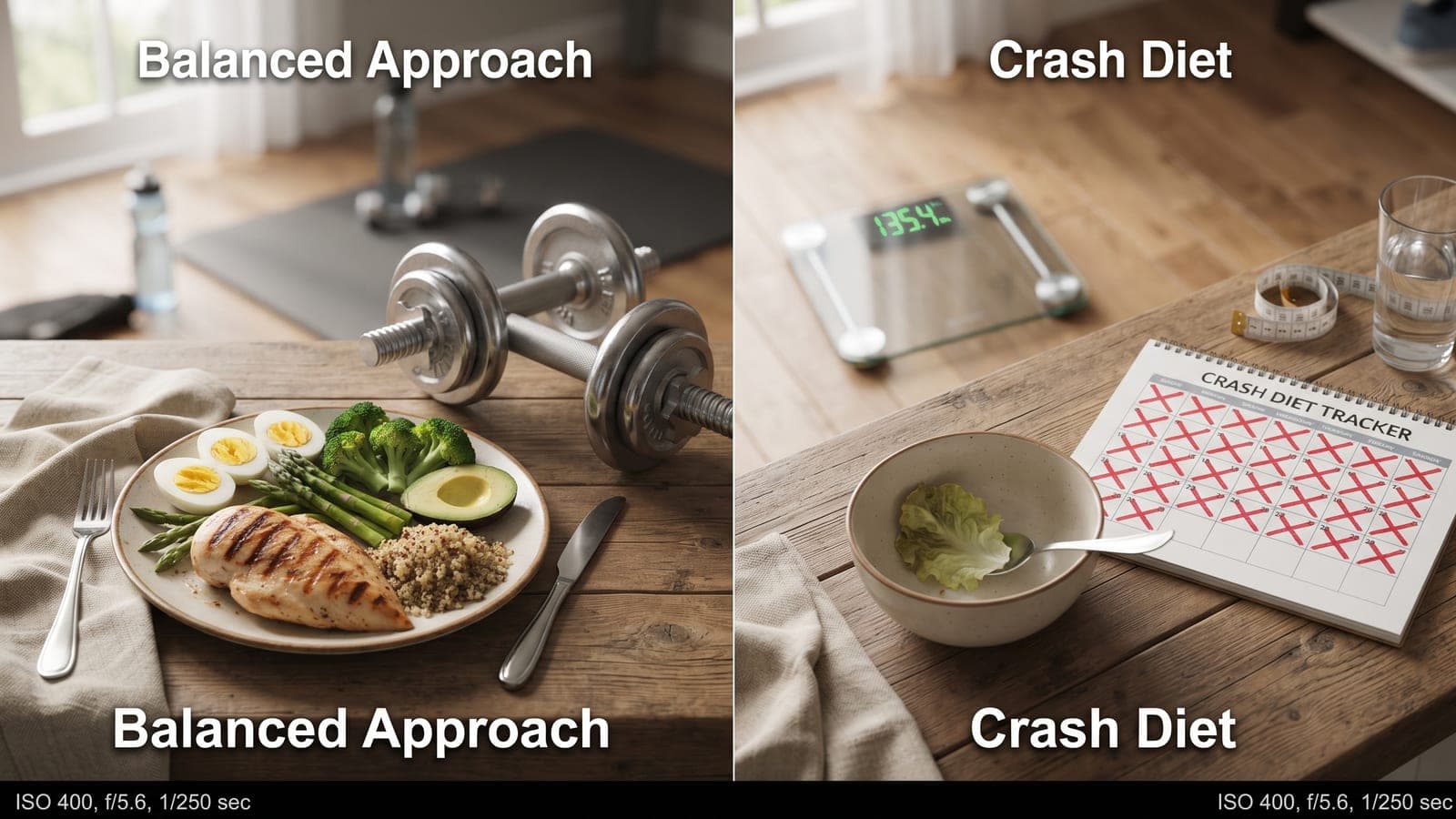
Sustainable Weight Loss: What "1kg a Week" Actually Costs Your Body
Losing a kilo a week is possible. What the promise leaves out is how much of it is muscle, what it does to your training, and why the weight usually comes back. Here is the honest arithmetic.