
7 Diet Myths Pakistani Clients Ask Me About Every Week
Rice makes you fat, ghee is healthy again, lemon water burns belly fat. Here are the seven claims that come up in almost every consultation, and what the evidence actually says about each.
Fit with Faisal Noor
Certified Fitness Coach & Nutrition Specialist

Almost every first consultation includes at least two of these. They are not silly questions — they are what happens when nutrition advice arrives through WhatsApp forwards, television segments, and relatives who mean well.
Here are the seven I hear most, and what is actually true.
Why This Happens
Nutrition misinformation spreads faster than most subjects for a specific reason: everyone eats, so everyone has an opinion, and none of it requires a qualification to share.
It is also a field where partial truths travel further than complete ones. "Sugar causes weight gain" is close enough to true to sound authoritative, and wrong enough to send someone into eliminating fruit while their oil intake goes unexamined. The half-true version is more memorable than the accurate one, which usually needs a sentence of context.
The local layer adds another factor. Most fitness content is written for foreign diets, so when it fails to describe roti, salan, or chai, people fill the gap with folk wisdom. And folk wisdom about food here is old, confidently delivered, and frequently wrong.
What Most People Get Wrong
The underlying error in nearly every myth below is treating individual foods as the cause of body composition. Foods are not fattening or slimming. Total energy intake, sustained over months, is what changes your weight.
Once you see that, most of these dissolve. Rice is not the problem; six plates of rice is. Ghee is not a health food; it is a calorie-dense fat that is fine in small amounts. Almost every myth here is a real variable being blamed for the wrong thing.
The second error is looking for the single lever. People want the one food to remove. It is a more appealing idea than adjusting portions across the whole day, which is what actually works and sounds like far less of a discovery.
No single food made you gain weight, and no single food will take it off. That answer is unsatisfying, which is exactly why the myths keep circulating.
The Seven
1. "Rice makes you fat, roti is fine"
Neither is true in the way it is meant. A cup of cooked rice is roughly 200 calories; a medium roti is roughly 120. Per serving, rice is often the larger portion, which is where the reputation comes from — not from anything about rice itself.
If you prefer rice, eat rice. Measure the portion, and it fits any plan.
2. "Desi ghee is healthy, so it does not count"
Ghee has been rehabilitated in public conversation and overcorrected. It is a fat like any other: roughly 900 calories per 100 g, whatever its source or tradition.
There is nothing wrong with ghee. There is something wrong with assuming it is calorie-free because it is natural. Three tablespoons in a salan is nearly 400 calories that most people never count.
3. "Lemon water in the morning burns fat"
It does not. Lemon water is water with lemon in it, which is pleasant and hydrating and does nothing to fat tissue.
Where it appears to work: people who start drinking it often also start eating more carefully, because the habit is part of a general effort. The lemon is not the active ingredient.
4. "Eating after 7pm turns to fat"
Your body does not read a clock. What matters is the day's total, not its distribution.
This one persists because late-night eating is often unplanned eating — biscuits, leftovers, snacks nobody counts. The timing is a marker for the behaviour, not the cause.
If eating dinner at 9pm suits your schedule, eat dinner at 9pm.
5. "Skipping breakfast slows your metabolism"
It does not measurably. Meal frequency has very little effect on metabolic rate; the "breakfast is essential" claim came largely from observational studies where breakfast-eaters differed in many other ways.
Eat breakfast if it helps you control the rest of the day. Many people find it does. That is a preference and a strategy, not a metabolic requirement.
6. "You must cut carbs completely to lose weight"
Low-carb diets work for the same reason every diet works — they reduce total intake. They are not uniquely effective, and comparisons with matched calories and protein show very little difference.
For most people here, cutting carbs entirely means removing roti and rice from a cuisine built around them. That is a plan with a short lifespan. Reduce the portion, keep the food.
7. "Sugar-free and diet products help you lose weight"
Only if they replace something. A sugar-free biscuit still contains flour and fat, and "sugar-free" on a label routinely licenses eating three times as many.
Diet drinks in place of regular soft drinks are a genuine and worthwhile saving. Diet biscuits in addition to your normal diet are not.
The Pattern Underneath All Seven
Every one of these is an attempt to find a rule that removes the need to think about quantity. Cut rice, avoid evenings, drink the lemon water — and then portions do not have to be examined.
The unglamorous truth is that portion size and total intake decide the outcome, and every myth above is a way of avoiding that. Once you accept it, most of your food choices stop being moral questions.
If you want the practical version of this — what to actually eat with local food and real portions — start here, and work out your calorie number before changing anything else.
This week, pick the one myth you have been following and test it: count the calories in it honestly for four days. That usually settles the argument faster than any article.
Keep Reading

Supplements: What's Worth Your Money and What Isn't
Three supplements have solid evidence behind them. Most of the rest are selling you an expensive version of something food already provides. Here is the honest breakdown.

Water Intake and Weight Loss: Fact vs Overhyped Advice
Water does not burn fat, and drinking four litres will not speed anything up. What it does do is worth knowing — particularly the effect it has on the number you see on the scale.
Sustainable Weight Loss: What "1kg a Week" Actually Costs Your Body
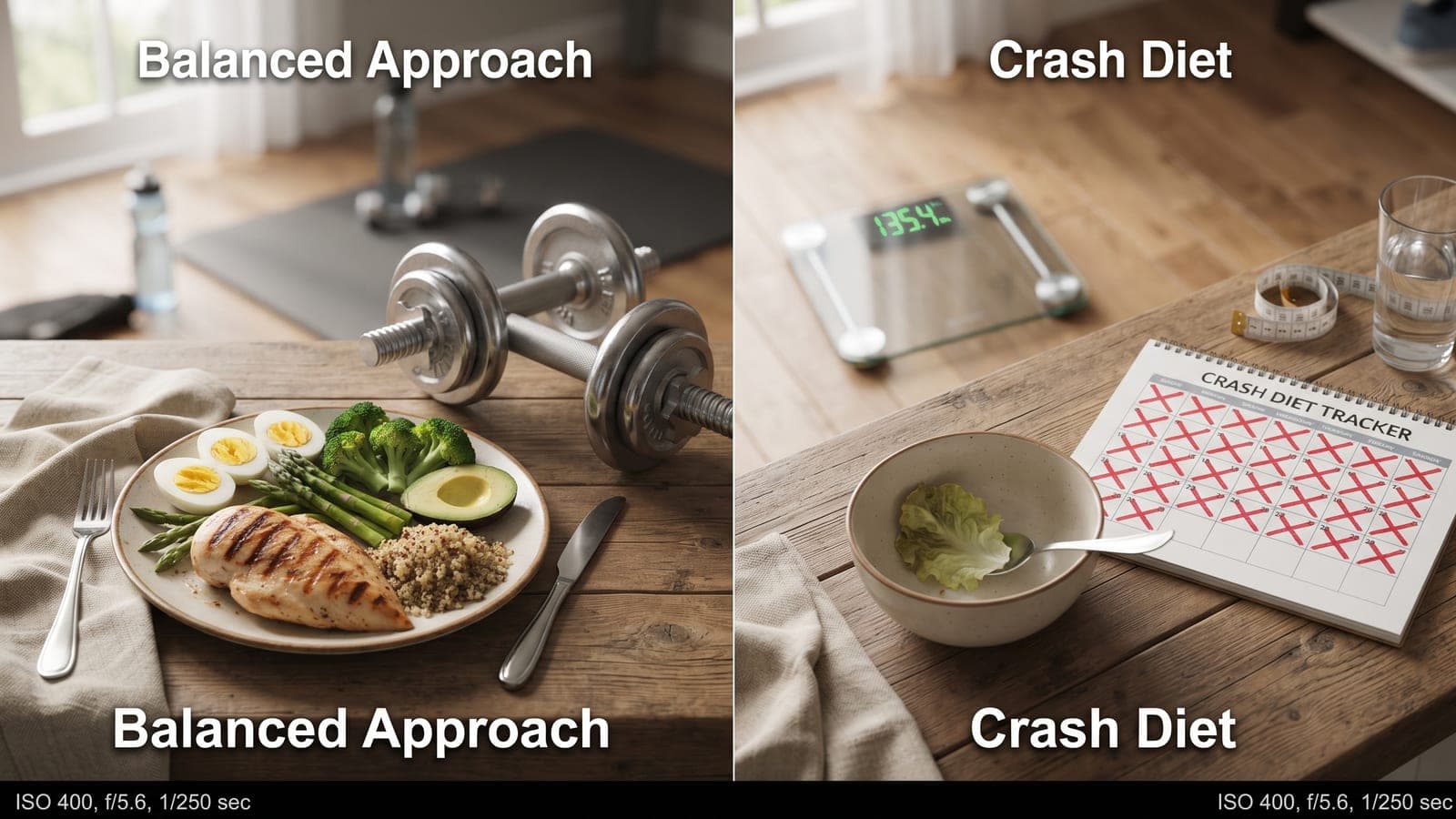
Losing a kilo a week is possible. What the promise leaves out is how much of it is muscle, what it does to your training, and why the weight usually comes back. Here is the honest arithmetic.