
How to Fix Bad Squat Form: A Coach's Checklist
Knees caving, heels lifting, depth cut short, back rounding. Here is what each fault is actually caused by — because the fix is almost never at the place where the problem shows up.
Fit with Faisal Noor
Certified Fitness Coach & Nutrition Specialist
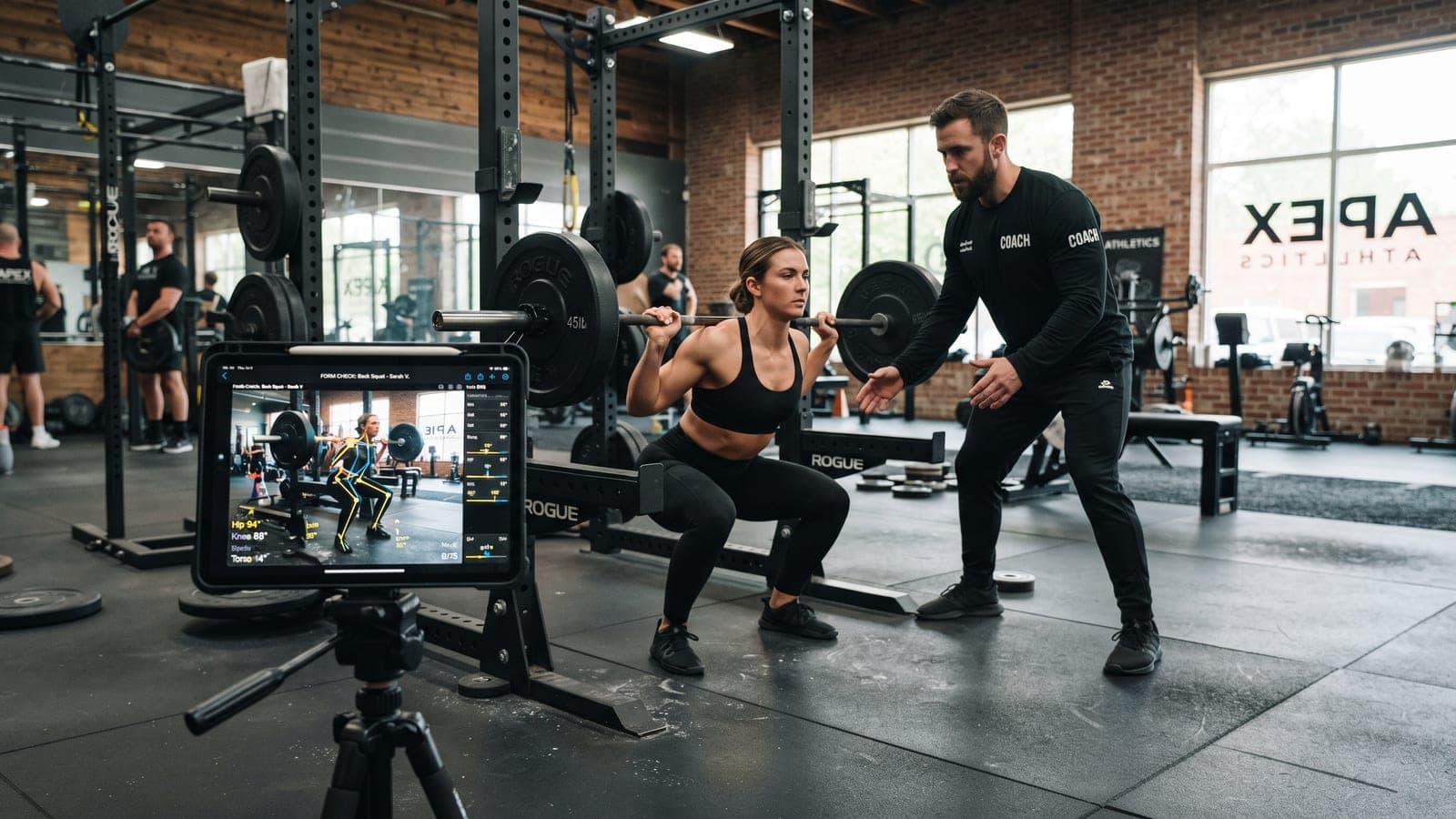
Someone told you your squat looks wrong, or you filmed it and did not like what you saw.
The useful question is not what looks wrong. It is what is causing it — because for nearly every squat fault, the fix is somewhere other than where the problem appears.
Why This Happens
A squat is a coordinated movement across ankles, knees, hips, and spine, under load. A limitation anywhere in that chain shows up as a compensation somewhere else.
Stiff ankles produce a forward-leaning torso. Weak glutes produce caving knees. A weak brace produces a rounding back. In each case the visible symptom is downstream of the actual cause, which is why "just push your knees out" often does not stick — you are correcting the symptom while the cause remains.
The second factor is load exposure. Technique that holds at 40 kg frequently breaks at 70. This is normal and it is information: the fault was always there, and load revealed it.
What Most People Get Wrong
Cueing the symptom. Telling someone to keep their heels down when their ankles cannot dorsiflex enough does not work. They will comply for one rep and revert.
Assuming everyone should squat identically. Hip anatomy varies genuinely between people — socket depth and angle differ, and they determine your best stance width and foot angle. There is no single correct squat position, and forcing one causes problems.
Chasing depth at any cost. Depth matters, but a rounding lower back at the bottom is worse than stopping just above parallel. Earn the depth; do not force it.
Practising the fault under load. Every rep with caving knees rehearses caving knees. Reduce the weight until the pattern is correct, then rebuild — this is faster than it sounds.
Almost no squat fault is fixed at the place you can see it. Knees cave because of hips. Heels lift because of ankles. The back rounds because of the brace.
The Fix: Fault by Fault
Knees caving inward
Cause: weak glute medius, stance too narrow, or feet too straight.
Fix: widen your stance slightly, turn toes out 15–30 degrees, and actively push knees outward throughout. Add banded lateral walks and glute bridges twice a week.
Heels lifting off the floor
Cause: limited ankle dorsiflexion, almost always.
Fix: ankle mobility work before training — a knee-to-wall stretch, three sets of ten each side. In the meantime, squat in flat shoes with a small heel elevation (a 2.5 kg plate under each heel). This is a legitimate long-term solution, not only a workaround.
Cutting depth
Cause: usually the weight is too heavy; sometimes mobility.
Fix: drop to a weight you can take to depth for all reps and rebuild. Squat to a box set just below parallel so depth is unambiguous. Nearly everyone finds their real working weight is lower than they believed — and progress restarts immediately.
Lower back rounding at the bottom
Cause: weak brace, going deeper than mobility allows, or too much load.
Fix: this is the one with genuine injury risk, so address it directly. Learn to brace — big breath into the belly, tighten as if about to be punched, hold through the rep. Stop at the depth where your back stays flat, and expand from there over months.
Excessive forward lean
Cause: ankle restriction, weak quads, or a bar position mismatch.
Fix: work ankle mobility, elevate the heels, and consider front squats or goblet squats temporarily — both force an upright torso by design.
Hips shooting up first
Cause: quads not strong enough relative to the posterior chain, so the lift turns into a hinge.
Fix: pause squats — three seconds at the bottom — and tempo work. Reduce the weight substantially; this fault only appears above your true capacity.
The checklist, in order
Run through this before each set:
- Feet shoulder-width, toes out 15–30 degrees
- Weight through the mid-foot, whole foot planted
- Big breath, brace the trunk
- Knees track over toes, pushed out
- Descend to depth where the back stays flat
- Drive up through the mid-foot, knees still out
How long a fix takes
Expect this to be measured in weeks, not sessions.
A mobility limitation — ankles, hips — improves over 4–8 weeks of consistent daily work. There is no shortcut, and stretching once before a session does very little.
A strength imbalance, such as weak glutes causing caving knees, takes 6–12 weeks of dedicated accessory work.
A motor pattern — the movement itself — corrects fastest, often within two to three weeks, provided you reduce the weight enough to perform it correctly every rep.
The common thread is that all three require you to train lighter for a while. That is the actual cost of fixing form, and it is why people avoid it. It is also why their squat has not moved in a year.
Checking Your Own
Film from 45 degrees to the front, at roughly hip height, capturing your whole body including feet. Record a full working set at a challenging weight — faults appear as fatigue accumulates, so the clean first rep tells you nothing.
Watch it once at normal speed, once slowed down. Most people spot the obvious fault within thirty seconds.
What is harder to self-diagnose is which cause is yours, since caving knees could be stance, mobility, or strength — and the wrong fix wastes months. That is what the form review on the supported course tiers is for.
Film your next working set before you change anything. You cannot fix what you have not seen.
Keep Reading
What a Strength Training Form Check Actually Catches (With Examples)
Most people think form checks are about avoiding injury. That is part of it — but the more common finding is that you are working the wrong muscle entirely, which is why the lift stopped progressing.

Rest Days: Why Skipping Them Is Slowing Your Progress
Training is the stimulus. Recovery is where the adaptation actually happens. If you train seven days a week and wonder why nothing is improving, this is usually the reason.

The 5 Exercises Everyone Should Master Before Anything Fancy
Before cable crossovers and Bulgarian drop sets, there are five movement patterns that cover the entire body. Master them and most of the gym becomes optional.