
The 5 Exercises Everyone Should Master Before Anything Fancy
Before cable crossovers and Bulgarian drop sets, there are five movement patterns that cover the entire body. Master them and most of the gym becomes optional.
Fit with Faisal Noor
Certified Fitness Coach & Nutrition Specialist

You have seen someone doing an exercise you cannot name, on a machine you have never used, and concluded that your training is too basic.
It probably is not. Most advanced-looking work is a variation on five patterns, and someone who is genuinely strong at those five will out-perform someone who has collected forty exercises and progressed at none of them.
Why This Happens
Gyms are full of equipment, and equipment implies necessity. Forty machines suggests forty things you ought to be doing.
But the body does not have forty movement categories. It has a handful: it pushes, it pulls, it squats, it hinges, and it braces against load. Every exercise in the building is a variation on one of those, differing mainly in how the resistance is applied.
The five below are chosen because they are compound movements — several joints and large muscle groups working together. That matters for two reasons. They produce more stimulus per unit of time than isolation work, and they train the coordination between muscles that isolation exercises specifically remove.
There is also a skill argument. These are the movements that take longest to learn and carry the most load, which means they are the ones worth practising while the weights are still light.
What Most People Get Wrong
Adding variety to avoid boredom. Changing exercises weekly feels like progress and prevents it. You cannot progressively overload a movement you did once last month, and progression requires repetition of the same lift.
Starting with isolation work. Arms grow from rows and presses long before they grow from curls. Beginning with curls and lateral raises is training the small muscles while leaving the large ones untouched.
Choosing machines over free weights by default. Machines fix the movement path, which removes the stabilising work that free weights demand. They have a place, particularly for isolating a lagging muscle, but as a foundation they teach less.
Assuming difficult means effective. An exercise that is hard to balance is not necessarily building anything. Standing on a bosu ball doing bicep curls is difficult and nearly useless.
Five movements, trained properly for a year, will do more than forty exercises rotated for the same year. Depth beats variety when you are building a foundation.
The Five
1. Squat — knee-dominant lower body
Trains: quads, glutes, core.
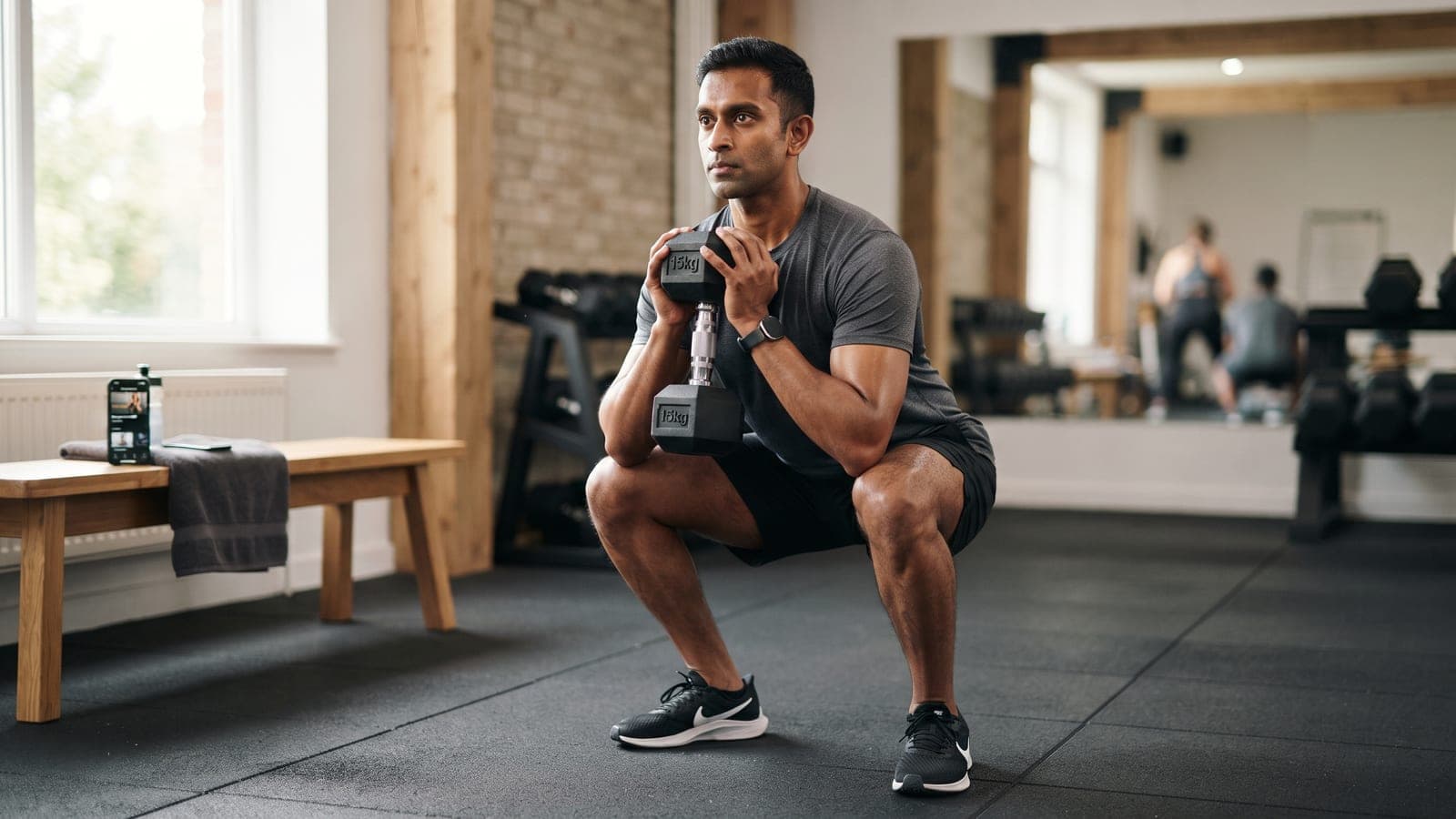
Start with a goblet squat, holding a single dumbbell at chest height. It naturally corrects posture, keeps the torso upright, and teaches depth. Progress to barbell squats when you have the pattern.
The standard to reach: thighs at least parallel, knees tracking over toes, back flat.
2. Hinge — hip-dominant lower body
Trains: hamstrings, glutes, lower back.
The Romanian deadlift is the entry point. The distinction from a squat is the movement: hips travel backwards, knees stay mostly fixed, chest stays proud.
This is the pattern most people get wrong, and the one most worth learning properly. It is also what protects your lower back when you lift anything in ordinary life.
3. Push — upper body pressing
Trains: chest, shoulders, triceps.
Press-ups first — they are free, they progress a long way, and they teach a braced torso. Move to a dumbbell or barbell bench press when press-ups are comfortable for twelve clean reps.
4. Pull — upper body pulling
Trains: back, biceps, rear shoulders.
Dumbbell rows or, once you can, pull-ups. This is the pattern most commonly neglected, and neglecting it produces both a visible imbalance and a rounded posture.
Pull at least as much volume as you push. Most people do the reverse.
5. Carry — loaded bracing
Trains: core, grip, everything stabilising.
Pick up two heavy dumbbells and walk. That is the whole exercise, and it builds trunk stability more effectively than most ab work.
How to programme them
Three full-body sessions a week, one movement from each pattern:
| Sets × Reps | |
|---|---|
| Squat | 3 × 8–12 |
| Hinge | 3 × 8–12 |
| Push | 3 × 8–12 |
| Pull | 3 × 8–12 |
| Carry | 3 × 30–40 m |
Forty minutes, full body, nothing skipped. The first four weeks look like this.
The order to learn them in
If you are starting from nothing, do not attempt all five loaded in week one.
Learn the squat and push first — they are the most forgiving and build confidence quickly. Add the pull in week two. Introduce the hinge last among the main four, because it is the one where poor form carries genuine risk and it benefits from you already understanding how to brace.
The carry can be added at any point; it needs almost no technique.
This ordering matters more than it sounds. Most people who hurt themselves early did so on a hinge they attempted before they could brace properly.
When to Add Anything Else
Add accessory work when you can answer why. "My shoulders are lagging behind my chest" is a reason to add lateral raises. "It looked interesting" is not.
A practical benchmark: once you can squat and hinge with reasonable load for three sets of ten with clean form, and manage a set of pull-ups, you have earned the right to specialise. Most people reach that in six to twelve months, and most never get there because they were busy collecting exercises instead.
This week, cut your session down to these five. Nearly everyone finds it harder than what they were doing before.
Keep Reading

Progressive Overload Explained: The One Concept Most Beginners Skip
If your workouts look the same today as they did three months ago, your body has no reason to change. This is the principle that separates people who progress from people who just attend.
Beginner's Guide to Strength Training: What to Do in Your First 4 Weeks
Your first month decides whether training becomes a habit or another abandoned attempt. Here is exactly what to do, how much to lift, and why doing less than you can is the right call early on.

Rest Days: Why Skipping Them Is Slowing Your Progress
Training is the stimulus. Recovery is where the adaptation actually happens. If you train seven days a week and wonder why nothing is improving, this is usually the reason.